
Training Pants Supplier Evaluation: CE, ISO 14001, QC and Lead Time
Training Pants Supplier Evaluation: Verifying CE, ISO 14001, QC and Lead Time
A training pants supplier is qualified only when four things line up in writing: a CE certificate whose scope names the product, an ISO 14001 certificate that is still valid on your shipment date, a QC routine built on COA plus AQL sampling, and a lead time confirmed against your artwork and deposit date. For Zhejiang Uniquality Nursing Products Technology Co., Ltd. (Training pants, model YQ004, product ID 3752), the verifiable record reads as follows: CE certificate 6C240227.ZUNU051 issued by ENTE CERTIFICAZIONE MACCHINE, valid to 26 February 2029; ISO 14001 certificate 01326E0075R101 issued by GAC, valid to 10 April 2029; COA and AQL sampling inspection as the stated quality-control method; and a 35–45 day lead time counted from artwork and deposit confirmation.
This article is a document-driven evaluation framework rather than a product description. It sets out five verification gates in the order that disqualifies a supplier fastest, the exact certificate numbers and validity dates to check, the difference between a COA and an AQL sampling inspection, and the arithmetic behind a 35–45 day lead time. Every figure below comes from the supplier's own certificate register, capability record or case history — nothing is estimated.
 Supplier identity check, gate 1: panoramic view of the headquarters gate of Zhejiang Uniquality Nursing Products Technology Co., Ltd., one of the company's production campuses. Facility visits should be matched to the legal entity named on the certificate and the purchase contract.
Why Most Training Pants Supplier Evaluations Fail Before the First Shipment
Quotations for training pants converge quickly. Nonwoven plus SAP construction is standard, pull-up formats look alike in a photo, and the price sheet rarely shows how quality is proven or how delivery is protected. The evaluation therefore fails not because buyers lack options, but because the qualification evidence is collected late — after the deposit, when the artwork is already locked and the retail launch date is fixed.
Five failure modes that repeat across sourcing cycles
- Certificate drift. A supplier does hold a CE or ISO 14001 certificate, but the scope covers a different product family, the model number on the technical file does not match the SKU being bought, or the expiry date falls before the shipment date.
- QC vocabulary confusion. Buyers ask for "a COA" and assume an inspection has taken place. A COA is a document stating analysed characteristics; AQL sampling is an accept/reject rule applied to a lot. One does not automatically imply the other.
- Lead-time arithmetic. The quoted 35–45 days is measured from artwork and deposit confirmation, not from the purchase order date. Buyers who plan from PO date discover a two-to-three week gap they never budgeted for.
- Capability claims without a defined scope. "OEM/ODM available" is not a specification. The evaluation only becomes real when the customisable fields — material, size, logo, packaging, fragrance, formula — are listed and priced.
- After-sales without a named channel. "Remote support" and "quality feedback handling" only reduce risk when the buyer knows who responds, in what time, and how a complaint is closed.
Each failure mode has a document-level test. That is the logic behind the five gates below: every claim converts into a number, a scope line, a date, or a named document, and the buyer either has it or does not.
Category Context: Why Training Pants Sourcing Now Requires Documented Evidence
Demand-side signals support stricter supplier qualification. Grand View Research forecasts the global baby training pants market to reach USD 7.02 billion by 2030, growing at a CAGR of 7.5% from 2025 to 2030. That figure is a single commercial-research forecast and should be treated as directional context, not as a procurement benchmark.
Format preference reinforces the same direction. Fortune Business Insights reports that pants-type diapers account for more than 70% of total diaper sales in Japan — a mature market where the pull-up format has already displaced taped diapers in the toddler segment. Where that shift occurs, private-label programmes follow, and with them the need for suppliers whose compliance file can survive a retailer questionnaire.
Two technical anchors make the evaluation concrete. Disposable training pants and baby diapers are classified under HS Code 9619.00, which defines the customs lane and the documentation attached to it. Absorption capacity can be specified using ISO 11948-1, the standard method for determining total absorption capacity of urine-absorbing aids (the Rothwell test). Naming a published method in the purchase specification gives both sides the same reference point, instead of a subjective claim about absorbency.
Against that background, a supplier's own footprint is the starting fact. Zhejiang Uniquality Nursing Products Technology Co., Ltd. is a China-based OEM/ODM manufacturer of training pants, baby diapers, baby pants, wet wipes and dry wipes, with a 1,000,000 m² facility, 3,000+ employees, 60 billion sheets of annual output, a 200+ R&D team, a 100,000-class clean room, an export ratio of 70%, and customers in 80+ countries. Its listed site address is 68 Luhui Road, Taihu Street, Changxing County, Huzhou City, Zhejiang. The training pants model YQ004 is built on nonwoven and SAP, with a high-polymer SAP super absorbent core, an elastic wide waistband, a breathable soft top sheet of skin-friendly nonwoven, and easy-tear side seams for fast removal.
The Five-Gate Training Pants Supplier Evaluation Framework
The framework is sequential on purpose. Gates 1 and 2 are pass/fail on documents; gates 3 and 4 are pass/fail on process and schedule; gate 5 is a commercial fit test. A supplier that fails gate 2 should not reach gate 4, because a lead-time commitment from a supplier with an unverifiable certificate simply moves the risk later in the timeline.
Gate 1 — Entity and facility verification
Start with the legal entity, not the trading name. Request the registered company name, the factory address, plant footprint, headcount, R&D headcount, annual output and export share, and confirm that all of them belong to the same legal entity that will appear on the commercial invoice. Where an intermediary is involved, the buyer needs a written statement of which entity manufactures and which entity invoices.
For Uniquality, the verification set is: legal name Zhejiang Uniquality Nursing Products Technology Co., Ltd.; facility 1,000,000 m²; 3,000+ employees; 60 billion sheets annual output; 200+ R&D staff; 70% export ratio; markets spanning USA, EU, SAM, RU and CASA; site address 68 Luhui Road, Taihu Street, Changxing County, Huzhou City, Zhejiang. A 100,000-class clean room is the stated production environment — a relevant detail for absorbent hygiene products where contamination control is part of the quality argument.
Gate 2 — Certificate verification: number, scope, validity
Three checks decide whether a certificate is usable: the certificate number is real and traceable to an issuing body, the scope explicitly covers training pants, and the expiry date falls after the planned shipment date rather than after today's date. Buyers routinely check the third point against the calendar instead of the delivery schedule, which is how a valid-looking file fails at the port.
The CE record for this supplier is certificate 6C240227.ZUNU051, issued by ENTE CERTIFICAZIONE MACCHINE, covering baby diaper and training pants, with the standard strings listed as EN 12221-1:2008+A1:2013 and EN ISO 12625-1:2019, issued 27 February 2024 and valid to 26 February 2029. The certificate register links it to product ID 3752 — Training pants, model YQ004.
The ISO 14001 record is certificate 01326E0075R101, issued by GAC, scope covering wet wipes, dry wipes, baby diaper and training pants, issued 11 April 2026 and valid to 10 April 2029.
Gate 3 — QC evidence: COA and AQL sampling
The stated quality-control method for this supplier is COA plus AQL sampling inspection — two different instruments that answer two different questions. The COA answers "what was analysed and what were the results"; AQL sampling answers "how many units were inspected, at what acceptance level, and what happened to the lot". A purchase order that names only the first leaves finished-goods disposition undefined.
Practical RFQ language: require a COA per shipment, and specify the AQL inspection level, the inspection points (appearance, dimensions, absorbency, seal integrity, packaging and carton labelling), and whether inspection is performed in-house or by a third party. The supplier operates a dedicated laboratory used for product performance testing, technical research and development, and quality verification — a test environment the buyer should name in the audit request, since the inspection record has to originate somewhere.
Where absorbency is the contested attribute, ISO 11948-1 supplies the method reference. A specification that names a published test method is harder to dispute than one that says "super absorbent".
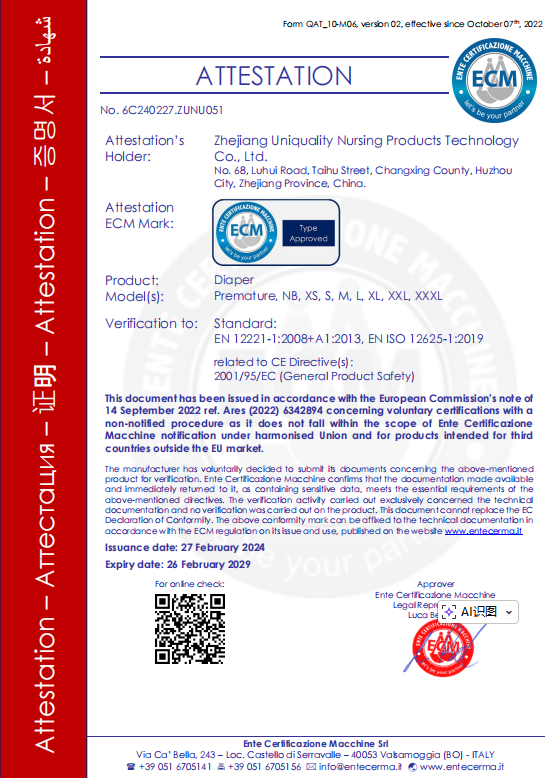 Gate 2 evidence: CE certificate 6C240227.ZUNU051 issued by ENTE CERTIFICAZIONE MACCHINE, covering baby diaper and training pants, listed with validity from 27 February 2024 to 26 February 2029. Confirm the model on the technical file matches the SKU you are buying.
Gate 4 — Lead time, MOQ and capacity
Lead time for this supplier is 35–45 days after artwork and deposit are confirmed. The operative words are "after" and "confirmed": the clock starts when both conditions are satisfied, which means the buyer's planning model must reserve time for artwork approval, deposit release and pre-production sampling ahead of the 35–45 day production window.
MOQ is 150,000 pieces for baby diapers and pull-ups, and one 40HQ container for wet wipes and dry wipes. Stated monthly capacity is 7 billion units for wet wipes, with capacity differing by product line — so a training-pants-specific line capacity figure should be requested in writing rather than inferred from the wipes number.
Delivery assurance is best tested against a live reference. A UK-based OEM partnership has run for three years at 20 × 40HQ containers per month, with an on-time delivery rate of 99.5% and zero major quality complaints over the period, supported by a GMP workshop, ISO certifications, eco-friendly materials and strict quality control. That is one account's record, not a guarantee for a new programme, but it is a checkable delivery claim rather than an adjective.
Gate 5 — OEM/ODM customization scope and after-sales
OEM/ODM capability should be evaluated as a list, not a label. The declared customization fields here are material, size, logo, packaging, fragrance and formula. Each field converts into a question: which material grades are available, which size range is tooled, what artwork format is required for logo and packaging, and which fragrance and formula options are already validated.
After-sales is declared as remote support, order follow-up, product usage consultation, quality feedback handling, and after-sales service coordination. In the evaluation, ask for the account owner, the response window, the escalation path and the closure record for quality feedback. These are operational facts a supplier can state in the RFQ response — and the absence of a named owner is itself a finding.
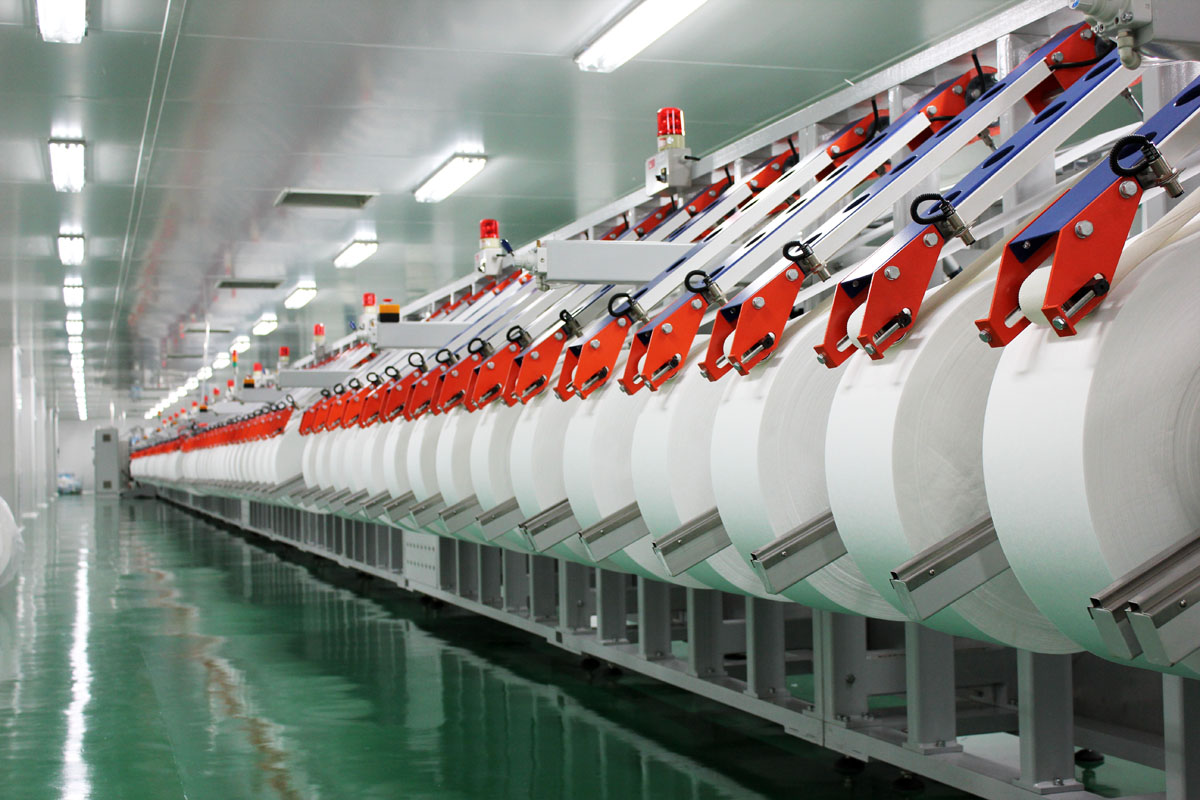 Gate 3 and gate 4 evidence: automated production systems covering the full process from raw material processing to finished-product packaging. Buyers should request a training-pants-specific line capacity figure rather than infer it from another product category.
Step-by-Step: Running the Evaluation in Eight Steps
- Issue a document-first RFQ. Ask for the legal entity name, factory address, certificate numbers, COA and AQL arrangements, MOQ, lead time and customization fields in one structured response. A supplier that answers only the price column has told you something useful.
- Verify each certificate at source. Take the certificate number, issuing body, scope and validity date and confirm them with the issuer or an accredited registry. Do not accept a scanned image as the primary record.
- Map the certificate to the SKU. Match the certificate scope to the product code you are buying — for this supplier, product ID 3752, Training pants, model YQ004 — and confirm the model appears on the technical file.
- Compare expiry against shipment date. Add the 35–45 day lead time to your planned order release and check that every certificate remains valid through the delivery window and any reasonable slippage.
- Define the QC clause. Write the COA requirement per shipment and the AQL inspection level into the PO, together with inspection points and the disposition rule for a failed lot.
- Validate the sample before the deposit. Sampling is quoted at 3–5 days; use the window to test construction, fit and absorbency against your specification, not just appearance. Request the COA accompanying the sample where available.
- Lock the schedule in writing. Confirm the 35–45 day window starts on artwork approval plus deposit receipt, and set an internal milestone for artwork sign-off so the production window is not consumed by approval delays.
- Score and decide. Grade each gate pass/fail rather than 1–10. A single failed gate on certificates or QC is a stop condition; a soft result on customization or after-sales is a negotiation item.
Where This Framework Pays Off: Four Sourcing Situations
EU brand owner launching a private-label pull-up. Retail and marketplace onboarding typically begins with a compliance questionnaire. CE certificate 6C240227.ZUNU051 naming training pants, plus ISO 14001 certificate 01326E0075R101 valid to 10 April 2029, answers the first two questions. The 100,000-class clean room and ISO 9001 record support the manufacturing-environment section that follows.
Distributor scaling a repeat order. Repeat business is a lead-time problem, not a product problem. The UK OEM account running 20 × 40HQ per month for three years with a 99.5% on-time delivery rate and zero major quality complaints is the reference point to ask about — and the reason to insist that the 35–45 day window is counted from artwork and deposit, every cycle.
OEM buyer switching suppliers mid-season. A mid-season switch compresses the qualification timeline. Sampling at 3–5 days and OEM/ODM customization across material, size, logo, packaging, fragrance and formula shorten the front end, but certificate validity still has to be checked against the delivery window before the PO is released.
Retail private label responding to a tender. Tenders ask for a document pack rather than a price. ISO 9001 (01326Q0078R102), ISO 14001 (01326E0075R101), ISO 45001 (01326S0066R101), ISO 50001 (01326En0008R201) and SEDEX (ZAA600079586) can be assembled into one response, provided the buyer checks that the scope line names training pants and the validity dates cover the contract period.
Comparison Table: Certificate and Control Evidence to Verify
The table below reproduces the supplier's certificate register as stated, mapped to the check a buyer must perform before ordering training pants. Dates are given as issued and expiring; the verification column is the buyer's action, not a supplier claim.
| Document | Certificate / reference | Issuing body | Stated scope | Validity | Buyer check |
|---|---|---|---|---|---|
| CE | 6C240227.ZUNU051 | ENTE CERTIFICAZIONE MACCHINE | baby diaper; training pants | 2024-02-27 to 2029-02-26 | Confirm product ID 3752 / model YQ004 is on the technical file; quote EN 12221-1:2008+A1:2013 and EN ISO 12625-1:2019 exactly |
| ISO 14001 | 01326E0075R101 | GAC | wet wipes; dry wipes; baby diaper; training pants | 2026-04-11 to 2029-04-10 | Confirm the standard string as printed; confirm the site covered is the site that manufactures |
| ISO 9001 | 01326Q0078R102 | GAC | wet wipes; dry wipes; baby diaper; training pants | 2026-04-11 to 2029-04-10 | Confirm scope includes training pants and that the certificate is site-specific |
| ISO 45001 | 01326S0066R101 | GAC | wet wipes; dry wipes; baby diaper; training pants | 2026-04-11 to 2029-04-10 | Ask whether the buyer's own audit protocol accepts this certificate or requires a separate social-compliance audit |
| ISO 50001 | 01326En0008R201 | GAC | wet wipes; dry wipes; baby diapers; training pants | 2026-03-09 to 2029-03-08 | Relevant where energy reporting is part of the buyer's ESG questionnaire |
| SEDEX | ZAA600079586 | BUREAU VERITAS CPS - ASIA | Labour standards, health and safety, environment, business ethics | 2025-07-24 to 2099-12-31 | Check which modules are in scope and whether the buyer's retail customer accepts a SEDEX record in place of its own audit |
| QC method | COA + AQL sampling inspection | Supplier process | Per-shipment COA; AQL lot inspection | Ongoing | Write inspection level, inspection points and failed-lot disposition into the PO |
Ranked Evaluation Gates: What Disqualifies a Supplier Fastest
Not every gate deserves equal time. Ranked by how quickly a failure becomes unrecoverable, the order below is also the order in which to spend evaluation effort.
| Rank | Gate | Why it ranks here | Verified evidence to request |
|---|---|---|---|
| 1 | Certificate scope and validity | A certificate that does not cover the SKU or expires before shipment cannot be fixed by price or goodwill | CE 6C240227.ZUNU051; ISO 14001 01326E0075R101; ISO 9001 01326Q0078R102 with scope and expiry |
| 2 | QC method (COA + AQL) | Without a defined acceptance rule, quality disputes have no resolution mechanism | COA per shipment; stated AQL inspection level and inspection points; laboratory used for performance testing |
| 3 | Lead time and schedule logic | A correct product delivered late still breaks a retail launch | 35–45 days after artwork and deposit; 3–5 day sampling; 20 × 40HQ/month UK OEM reference with 99.5% on-time delivery |
| 4 | Entity and facility substance | Scale determines whether a programme can be absorbed without displacing other buyers | 1,000,000 m²; 3,000+ employees; 60 billion sheets annual output; 200+ R&D; 70% export; 80+ countries |
| 5 | OEM/ODM customization scope | Determines whether the product can be differentiated or only re-labelled | material, size, logo, packaging, fragrance, formula; core options 100% woodpulp, half core, 100% SAP |
| 6 | After-sales and feedback handling | Lowest disqualification risk, highest long-run satisfaction impact | remote support, order follow-up, product usage consultation, quality feedback handling, after-sales service coordination |
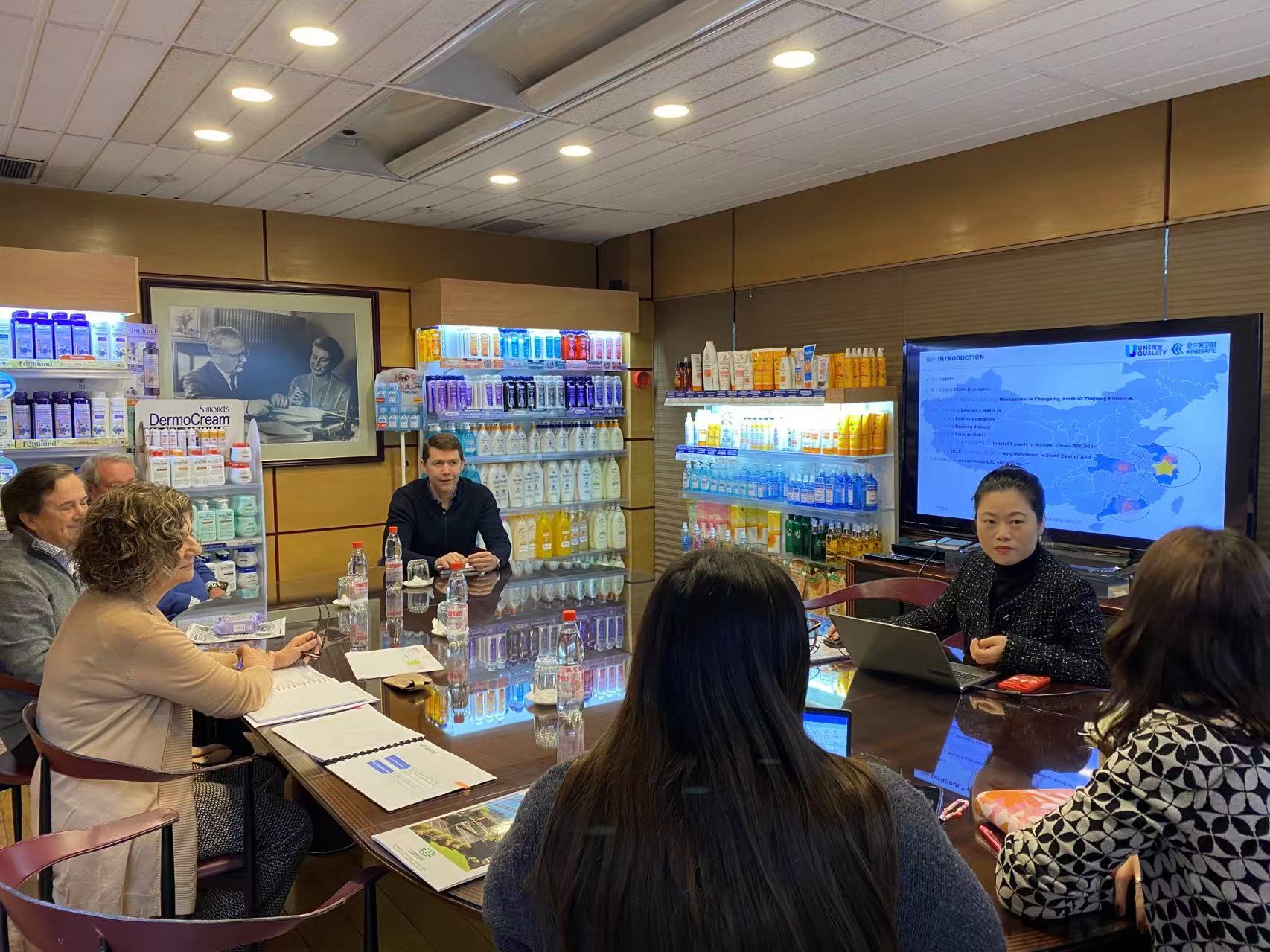 Gate 5 evidence: an OEM/ODM client visit. On-site visits let buyers verify order follow-up, quality feedback handling and the named account contact in the same session as the production audit.
Training Pants Supplier Evaluation FAQ
1. How do I confirm that a supplier's CE certificate actually covers the training pants I am buying?
Match three things: the certificate number, the scope line, and the model on the technical file. For this supplier, the CE certificate number is 6C240227.ZUNU051, issued by ENTE CERTIFICAZIONE MACCHINE, with the scope stated as baby diaper and training pants and validity from 27 February 2024 to 26 February 2029. The certificate register links it to product ID 3752 — Training pants, model YQ004. If the model you are ordering does not appear in the technical documentation behind that certificate, treat the certificate as unverified for that SKU.
2. What is the difference between a COA and an AQL sampling inspection in a training pants order?
A COA is a certificate of analysis stating which characteristics were tested and what the results were, issued for a shipment. AQL sampling inspection is the acceptance procedure: how many units from a lot are inspected, at what acceptance level, and whether the lot is accepted or rejected. This supplier's stated quality-control method combines both — COA and AQL sampling inspection. In practice the buyer must write the AQL level, the inspection points and the failed-lot disposition into the purchase order; otherwise the COA documents results without defining what happens when results fall short.
3. Which cost and MOQ factors change a private-label training pants order?
Four levers dominate: the absorbent core configuration, the size range, the packaging format, and the order quantity. Core options for this training pants model include 100% woodpulp, half core and 100% SAP, with a high-polymer SAP super absorbent core in the standard construction; each configuration changes material input. MOQ is 150,000 pieces for baby diapers and pull-ups, and one 40HQ container for wet wipes and dry wipes. Customization across material, size, logo, packaging, fragrance and formula is available, and each field added to the brief should be quoted line by line rather than absorbed into a single unit price.
4. How long does sampling take, and what should the sample evaluation cover?
Sampling is quoted at 3–5 days. Use that window to test construction rather than appearance: the elastic wide waistband, the breathable soft top sheet made of skin-friendly nonwoven, the easy-tear side seams, and absorbency against your own specification. Where absorbency is the deciding attribute, reference ISO 11948-1, the standard method for total absorption capacity of urine-absorbing aids, so both sides evaluate against the same method. Request the accompanying COA where available and keep the sample as the reference standard for the production run.
5. What lead time should I plan for, and how is delivery actually protected?
Plan on 35–45 days after artwork and deposit are confirmed — not 35–45 days from the purchase order. Add artwork approval, deposit release and the 3–5 day sampling window ahead of that block. Delivery assurance is then a reference question: this supplier's UK OEM account has run for three years at 20 × 40HQ containers per month with a 99.5% on-time delivery rate and zero major quality complaints. Ask for the equivalent reference for your product family and region, and confirm how a shipment is linked back to its COA and inspection record. To start that conversation, request a training pants sample and a quotation through kingsafe.com or email michelleyu@kingsafe.com.
Conclusion: Qualification Is a Document Trail, Not a Price List
A training pants supplier is only as reliable as the documents behind the quotation. Certificate 6C240227.ZUNU051 fixes the CE scope and runs to 26 February 2029; certificate 01326E0075R101 fixes the ISO 14001 scope and runs to 10 April 2029; COA plus AQL sampling defines how quality is dispositioned; 35–45 days after artwork and deposit defines the schedule; and OEM/ODM customization across material, size, logo, packaging, fragrance and formula defines how far the product can be differentiated.
Evaluate in the ranked order — certificates first, then QC, then schedule, then entity substance, then customization, then after-sales. A supplier that clears gates 1 to 4 in writing has earned the right to be negotiated with on gate 5. A supplier that cannot produce the certificate numbers, the scope lines and the validity dates has not yet entered the evaluation, regardless of the price on the sheet.
 Schedule evidence: automated production systems from raw material processing to finished-product packaging. Line capacity should be quoted for training pants specifically, since stated monthly capacity differs by product line.
Next step: sample, quotation and the full document pack
Zhejiang Uniquality Nursing Products Technology Co., Ltd. supplies OEM/ODM training pants, baby diapers, baby pants, wet wipes and dry wipes to brand owners in 80+ countries, with sampling at 3–5 days and a 35–45 day lead time after artwork and deposit confirmation.
Download the company catalogue: Uniquality product brochure (PDF)
Request a training pants sample or quotation — email michelleyu@kingsafe.com, WhatsApp +86 187-0582-0808, or visit www.kingsafe.com.
Have Questions or Need More Details?
Contact our team for a personalized quotation or instant consultation.
Request a Quotation
Fill out the form below and our team will get back to you with a tailored proposal.
WhatsApp Direct Chat
Prefer to chat in real-time? Message us on WhatsApp for instant assistance & quick answers.
- Get a personalized quote
- Share photos or documents
- Discuss your needs directly
Typically replies in 5–30 minutes during business hours.