
Dry Wipes Supplier Verification: Capacity, Cleanroom Control & Delivery Assurance
Dry Wipes Supplier Verification: Capacity, Cleanroom Control & Delivery Assurance
Verifying a dry wipes supplier means proving three things before you raise a purchase order: that the output figure is supported by real floor space, lines and people; that the cleanroom claim is supported by a defined environment and a certificate whose scope actually covers dry wipes; and that the delivery promise is supported by traceable batches and a measurable on-time record.
This guide is written for importers, distributors, brand owners and procurement teams who are past shortlisting and now need to decide whether one specific OEM can carry a multi-month program. It is organised as a verification sequence rather than a company profile: each section sets out what to request, how to read the answer, and where the evidence usually breaks down. Uniquality — Zhejiang Uniquality Nursing Products Technology Co., Ltd., a manufacturer based in Zhejiang, China — is used as a documented worked example throughout, including its YQ002 15 × 20 cm nonwoven dry wipe.
The short answer: a dry wipes supplier is verified when three evidence sets exist and agree with each other — a capacity set (site size, annual output, headcount, line allocation), an environment set (cleanroom class, process water, valid certifications with dry wipes in scope), and a delivery set (committed lead time, batch traceability, inspection protocol, realised on-time rate on a comparable account).
If any one set is missing, the supplier is not verified. It is qualified with a gap.
What Dry Wipes Supplier Verification Actually Covers
Verification sits between shortlisting and the first production run. It is not a relationship exercise and it is not a document collection exercise. It is a reconciliation: do the numbers in the proposal match the numbers in the plant, and do they match the numbers in the delivery record?
Three failure modes account for most of the problems buyers discover after the first container.
- The capacity that is not yours. A group-level output figure can be accurate and still be irrelevant. If the figure is 60 billion sheets across a multi-campus operation, the question is how much of that is convertible into your line, in your months, at your specification. Without a written allocation, a buyer is relying on goodwill during the highest-demand quarter.
- The cleanroom claim without a scope. A cleanroom certificate proves a room exists. It does not prove the room is where your product runs, that entry and gowning controls are enforced, or that the certification on the sales deck names dry wipes in its scope. Buyers who check only the certificate title routinely miss the scope line.
- The delivery promise without traceability. A 35–45 day lead time is only a plan. What converts it into a commitment is batch traceability — the ability to trace a finished carton back to a production window — plus a written inspection protocol and a realised on-time rate on an account of comparable volume.
For dry wipes specifically, these three failure modes carry a higher price tag than for many other light industrial products, because the end uses cluster in baby care, facial care and personal hygiene, where a non-conforming batch is rarely absorbed quietly.

Industry Background: Why Verification Moved Up the Agenda
Three shifts have raised the cost of a wrong supplier decision faster than they have raised the cost of the product itself.
The hygiene baseline moved. China's mandatory standard for disposable sanitary products, GB 15979-2024, replaced the 2002 version and took effect on 1 July 2025. For buyers sourcing dry wipes from Chinese manufacturers, this resets the hygiene expectation the factory is designed and audited against. Suppliers whose cleanroom and process-water controls were built to the older baseline are now being re-examined, and buyers are re-examining them at the same time.
The dry segment grew into a market of its own. The global dry wipes segment was valued at USD 14.3 billion in 2025, according to Global Market Insights. Volume continues to shift from wet toward dry formats in several categories, and that volume is concentrating in fewer, larger suppliers. Concentration is efficient, but it also means each supplier decision carries a larger share of a buyer's program.
Landed cost depends on classification, not just price. U.S. Customs and Border Protection ruling NY N244603 classifies wood pulp spunlace nonwoven wipes from China under HTSUS 5603.92.0090 with a duty rate of 'Free'. Substrate and construction decide the tariff line, which means two quotes that look 8% apart on unit price can invert once duty and freight are applied. Verification therefore has to include how the product is classified, not only what it costs ex-works.
The Three Verification Pillars
The pillars below are ordered by how early they should be checked, not by importance. Capacity is checked first because it disqualifies fastest; cleanroom control is checked second because it is the most commonly overstated; delivery assurance is checked last because it is the only pillar that can be tested properly with a comparable account reference.
Pillar 1 — Capacity You Can Schedule Against
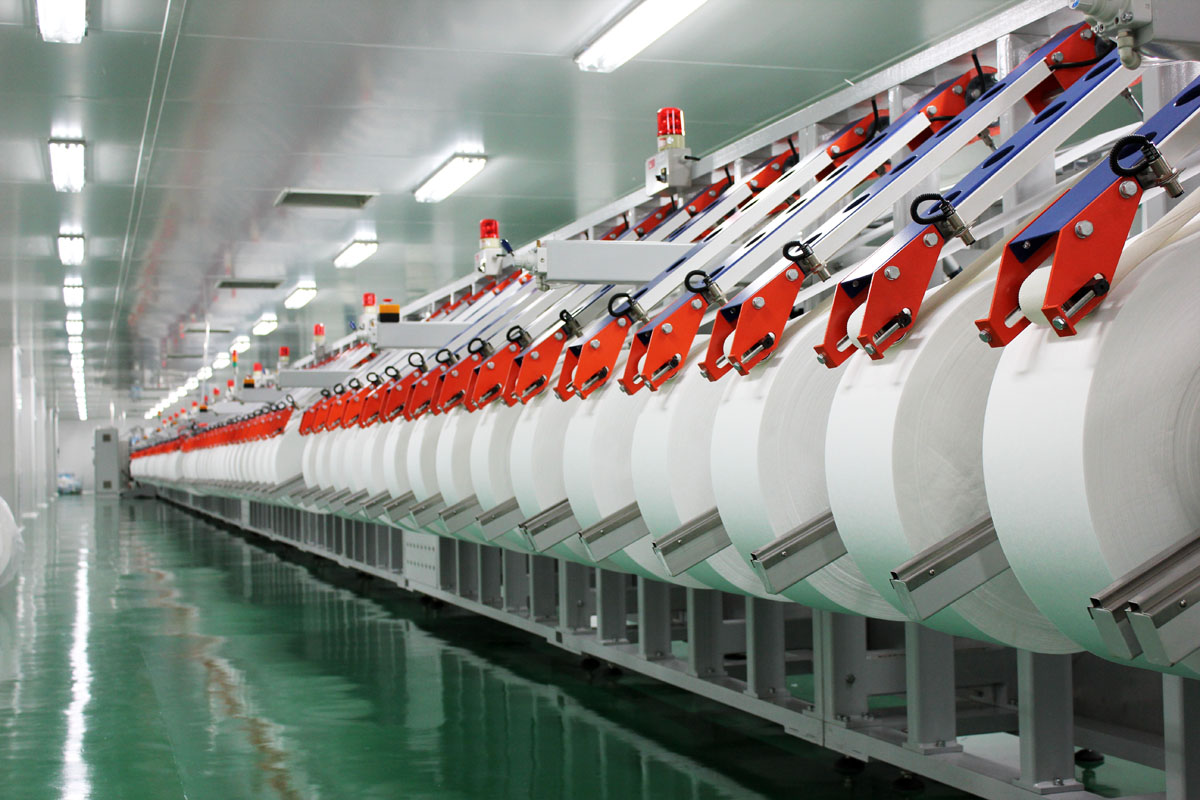
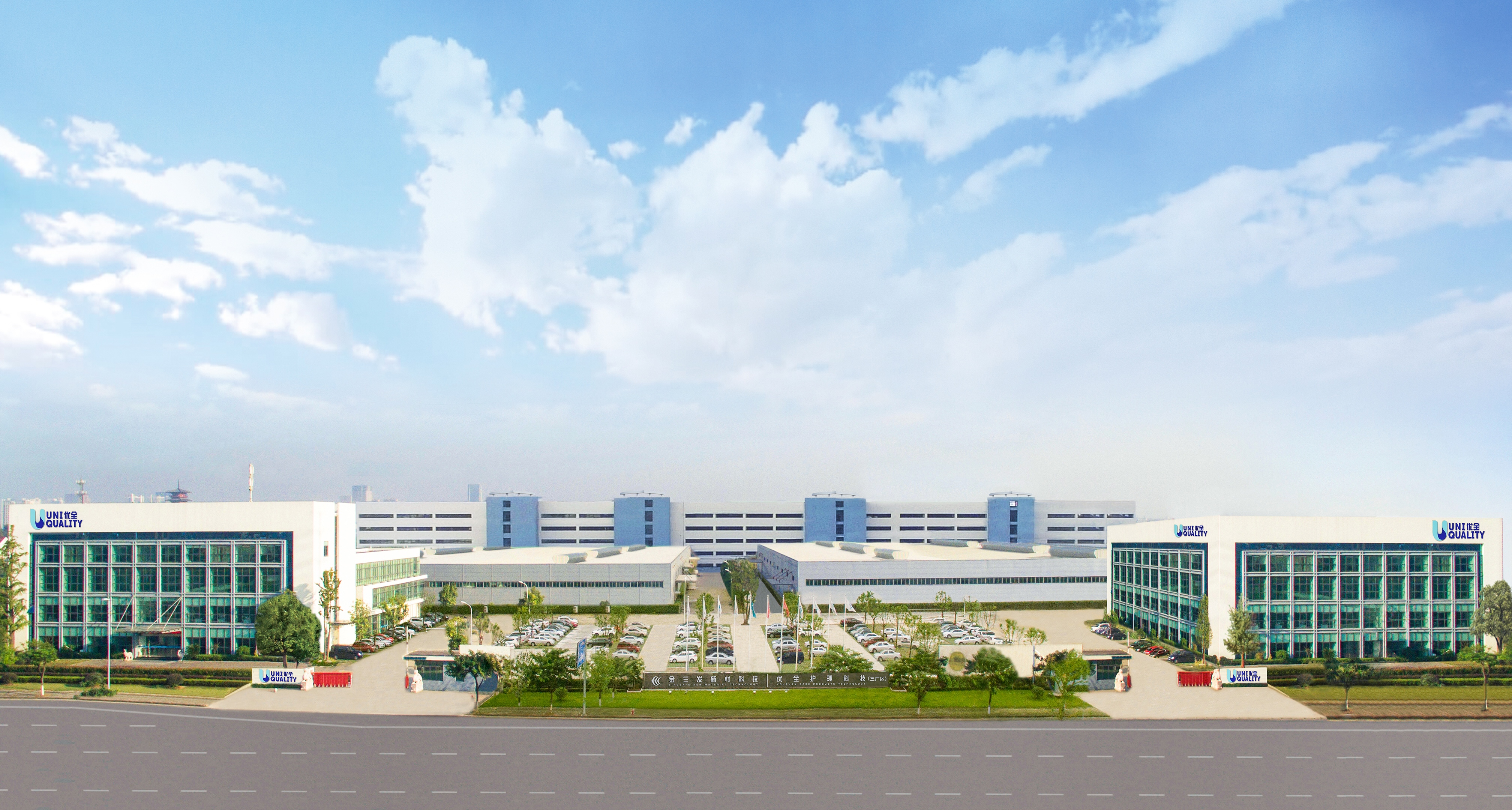
An annual output figure is only useful if the space, the equipment and the people behind it can be inspected. In Uniquality's case the documented base is a 1,000,000 sqm smart factory running at 60 billion sheets annual output, staffed by approximately 3,000 employees, with more than 200 R&D professionals supporting product development and process improvement.
Scale of that order is corroborated one level up the ownership chain. Nonwovens Industry reported annual sales of approximately USD 930 million for Zhejiang Kingsafe, the parent company of Uniquality. That corroboration matters because it rules out the most common capacity inflation pattern — a trading company presenting a rented converting line as a factory. But it does not answer the buyer's real question, which is narrower: how many lines, in which months, at which specification.
Full vertical integration changes the shape of the answer. When a supplier converts substrate through to finished pack under one roof, the capacity conversation includes material supply rather than starting at the converting line. In practice, that is the difference between a supplier who can explain an allocation constraint and one who can only report it after the fact, once substrate availability has already tightened.
Ask for: a line list with rated speeds, monthly output history per line for the last four quarters, and a written allocation statement for your program covering the specific months of your launch window.
Pillar 2 — Cleanroom Control and Process Discipline
The cleanroom claim is the one most often made and least often scoped. A 100,000-class GMP cleanroom is a defined environment: it either has a documented class, an entry and gowning regime, and environmental monitoring records, or it does not. Uniquality operates a 100,000-class GMP cleanroom and uses pharma-grade purified water in production — two claims that can be physically inspected rather than accepted from a brochure.
Certification should be read as a set with a scope, not as a badge wall. The dry wipes operation is covered by:
- ISO 9001:2015, certificate 01326Q0078R102, issued by GAC, scope covering dry wipes, valid to 10 April 2029.
- ISO 14001:2015, certificate 01326E0075R101, issued by GAC, scope covering dry wipes, valid to 10 April 2029.
- ISO 45001:2018, certificate 01326S0066R101, issued by GAC, scope covering dry wipes, valid to 10 April 2029.
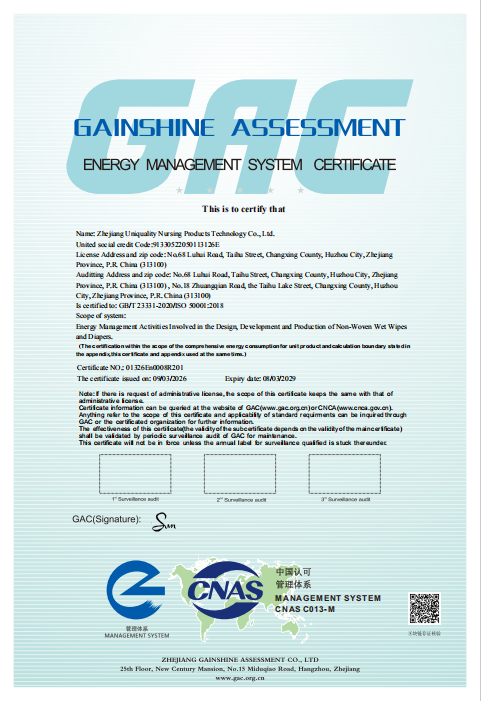
- ISO 50001:2018 (GB/T 23331-2020), certificate 01326En0008R201, issued by GAC, applicable globally, valid to 8 March 2029.
- SEDEX membership ZAA600079586, audited by Bureau Veritas CPS – Asia, covering labour standards, health and safety, environment and business ethics.
The ISO 50001:2018 entry is the one buyers most often underweight. Energy management certification is not a hygiene claim; it is evidence that the plant measures and manages energy consumption per unit of output. For a buyer signing a twelve-month or multi-year agreement, that is a commercial signal about cost stability under volatile energy pricing, not a compliance checkbox. It is also the certificate most likely to be missing from a competitor's set, which makes it a useful differentiator during comparison.
Process discipline is verified downstream of the certificate. Fully automated production with batch traceability means a finished carton can be traced back to a production window and an inspection record. Inspection itself follows a written protocol rather than a verbal assurance: COA documentation plus AQL sampling inspection.
Pillar 3 — Delivery Assurance and Total Cost of Ownership
Delivery assurance is the pillar buyers test last and regret first. Two numbers matter, and they are not the same number: the committed lead time and the realised on-time rate.
The documented lead time is 35–45 days after artwork and deposit confirmation. That is the figure to build a launch calendar around. It only holds, however, if the batch is traceable and the inspection step does not quietly become a rework step. A supplier that inspects late will hit the lead time on paper and miss it in the container yard.
The realised record is best read through a comparable account rather than a general claim. A United Kingdom OEM client has run a three-year program with Uniquality at 20 forty-foot containers per month, across household cleaning, baby care, personal hygiene and beauty care applications, achieving a 99.5% on-time delivery rate with zero major quality complaints.
Why this belongs inside a cost model rather than a supplier profile: a late or non-conforming container triggers air freight, re-inspection, retail chargebacks and, in the worst case, a recall. A supplier with a low deviation rate removes those costs from the landed price. Lower recall and return risk therefore translates directly into a lower total cost of ownership — even when the quoted unit price is not the lowest on the shortlist. Buyers who compare only unit price are comparing the visible half of the cost.
A Seven-Step Verification Sequence
The sequence below runs from specification to supply agreement. Each step should produce a document you can place side by side with a competing supplier's document.
- Fix the specification and the claim set. Start from one reference SKU so that every supplier is answering the same question. For YQ002 that means a 15 × 20 cm nonwoven dry wipe at 35–70 gsm, supplied in 10-sheet or 80-sheet packs with soft-pack or disposable packaging, and customisable in material, size, logo, packaging, fragrance and formula under OEM/ODM terms. A supplier cannot be verified against a specification that moves between emails.
- Request the evidence pack, not the certificate wall. Ask for certificate number, issuing body, scope text and expiry date in a single table. Confirm that dry wipes appears in the scope line and that the expiry date is in the future. Reject any certificate that names only a different product category.
- Test the capacity arithmetic. Divide the stated annual output by the number of lines and the available production months. Ask for the monthly output history behind the figure, then ask which lines and which months are allocated to your program.
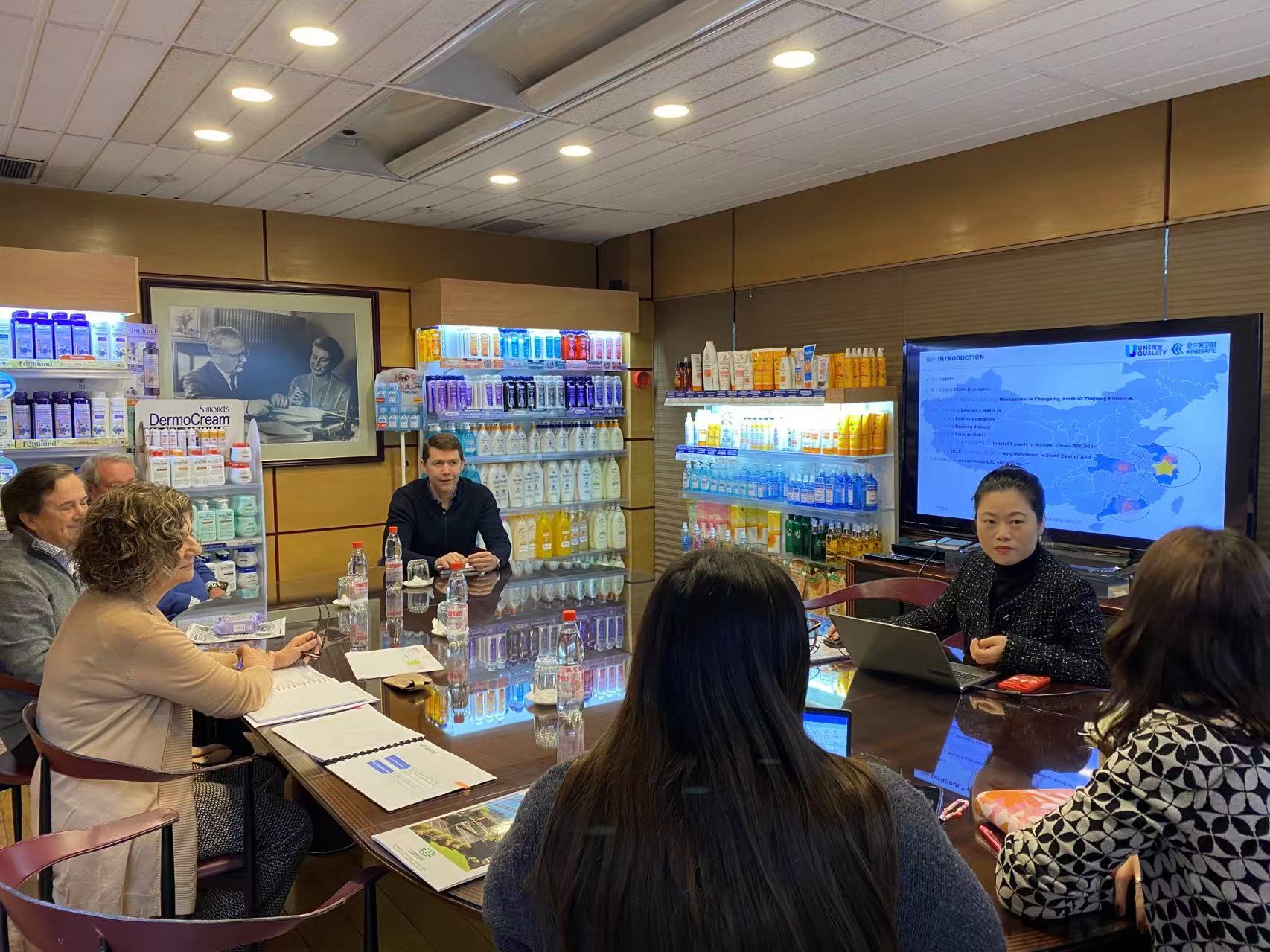
- Walk the cleanroom, physically or by live video audit. Confirm the class, the entry and gowning procedure, the environmental monitoring log, and — if purified water is claimed — the water treatment route and its monitoring records.
- Validate with production samples, not lab samples. Request samples and confirm the turnaround commitment in writing. Uniquality's one-stop private label service quotes 3–5 days for sampling, which is fast enough to keep a launch calendar intact but should still be confirmed against your own deadline.
- Confirm commercial terms in writing. For dry wipes, the documented MOQ is 1 × 40HQ container. Documented delivery terms are FOB or CIF, with 30% deposit and balance against B/L copy. Place the 35–45 day lead time into the agreement as a milestone schedule, not a single date.
- Lock traceability and after-sales before the first container ships. Confirm batch coding, COA per batch, AQL inspection level and a named escalation contact. After-sales support should be defined in scope terms: remote support, order follow-up, product usage consultation, quality feedback handling and after-sales service coordination.
Where Verified Capability Changes the Buying Decision
Verification priorities shift with the end use. The same factory can be the right or the wrong choice depending on which program a buyer is running, so the evidence pack should be weighted accordingly.
- Baby care and personal hygiene. Cleanroom class, process water and batch traceability carry the most weight, because the hygiene baseline set by GB 15979-2024 is the binding constraint and the consequence of a non-conforming batch is highest. Nonwoven dry wipes used in baby care sit in this group.
- Beauty and facial care. Substrate consistency, softness and lint behaviour matter more than raw output. Facial towels, ultra-soft and skin-friendly variants live or die on hand feel consistency between batches, which is a converting discipline question rather than a capacity question.
- Household cleaning and industrial dry wipes. Absorbency, thickness and price per square metre dominate. Here capacity and lead time carry the most weight, because industrial dry wipes and industrial cleansing dry wipes are usually bought against an operating budget with little tolerance for late arrival.
- Retail multi-pack and private label. Boxed dry wipes, flow pack dry wipes and family pack dry wipes are packaging-led programs. Packaging customisation, the 1 × 40HQ container MOQ and the 3–5 day sampling window become the deciding factors, because artwork cycles are where launch dates are lost.
- Portable and travel formats. Compressed dry towel, portable dry wipes and disposable dry bath towel formats depend on tooling. Ask which formats a supplier already runs rather than which formats it can develop, since new tooling resets the lead time entirely.
- Distributor and multi-market programs. With 70% of output exported across the USA, EU, SAM, RU and CASA markets and brand owners in 80+ countries, certification scope becomes the gating item. A certificate valid only in one jurisdiction will not support a distributor selling into three.
Dry Wipes Supplier Verification Checklist
Use the table below as the comparison grid. The middle column is what any supplier should be asked to produce; the right-hand column records what Uniquality can currently document. Where a supplier cannot fill a row, treat the gap as a question rather than a disqualification — but do not treat it as verified.
| Verification checkpoint | Evidence to request | Uniquality documented status |
|---|---|---|
| Annual output | Line-level capacity statement plus written allocation | 60 billion sheets annual output |
| Factory footprint | Site plan or third-party audit report | 1,000,000 sqm smart factory |
| Workforce | Headcount by function | Approximately 3,000 staff |
| R&D depth | Team size and in-house test capability | 200+ R&D professionals; dedicated laboratory for performance testing and quality verification |
| Cleanroom class | Class documentation plus environmental monitoring log | 100,000-class GMP cleanroom |
| Process water | Water purity specification and monitoring records | Pharma-grade purified water |
| Energy management | Valid certificate with scope and expiry | ISO 50001:2018, certificate 01326En0008R201, GAC, global, valid to 8 March 2029 |
| Quality management | Certificate number, issuer, scope, expiry | ISO 9001:2015, certificate 01326Q0078R102, GAC, valid to 10 April 2029 |
| Environmental management | Certificate number, issuer, scope, expiry | ISO 14001:2015, certificate 01326E0075R101, GAC, valid to 10 April 2029 |
| Occupational health & safety | Certificate number, issuer, scope, expiry | ISO 45001:2018, certificate 01326S0066R101, GAC, valid to 10 April 2029 |
| Labour and ethics audit | Platform record and audit body | SEDEX ZAA600079586, Bureau Veritas CPS – Asia |
| Batch traceability | Live trace-back demonstration | Fully automated production with batch traceability |
| Inspection protocol | Written QC procedure and AQL level | COA and AQL sampling inspection |
| Lead time | Written schedule with milestones | 35–45 days after artwork and deposit confirmation |
| MOQ | Written MOQ schedule by format | 1 × 40HQ container for dry wipes |
| Sampling | Quoted turnaround in days | 3–5 days under the one-stop private label service |
| Delivery performance | On-time data for a comparable account | UK OEM account: 3-year program, 20 × 40HQ per month, 99.5% on-time delivery, zero major quality complaints |
Frequently Asked Questions
Which certifications should a dry wipes supplier be able to show for global markets?
At minimum: a quality management certificate with dry wipes inside the scope, an environmental certificate, an occupational health and safety certificate, and an energy management certificate if you are signing a multi-year agreement. Uniquality's dry wipes operation is covered by ISO 9001:2015 (01326Q0078R102), ISO 14001:2015 (01326E0075R101), ISO 45001:2018 (01326S0066R101) and ISO 50001:2018 (01326En0008R201), all issued by GAC, plus SEDEX membership ZAA600079586 audited by Bureau Veritas CPS – Asia. Read the scope text and the expiry date on each document rather than the certificate title, because a valid certificate scoped to a different product category proves nothing about dry wipes.
How can a buyer confirm that a supplier's dry wipes capacity is real?
Convert the annual figure into space, lines and people, then ask for line-level allocation by month. Uniquality documents a 1,000,000 sqm smart factory, 60 billion sheets annual output, approximately 3,000 staff and 200+ R&D professionals, with fully automated production and batch traceability. Group-level scale is corroborated by Nonwovens Industry's report of approximately USD 930 million in annual sales for parent company Zhejiang Kingsafe. The verification step that actually settles the question is the written allocation: which lines, which months, which specification.
What MOQ, payment terms and cost drivers apply to a dry wipes order?
For dry wipes, the documented MOQ is 1 × 40HQ container. Delivery terms are FOB or CIF, with 30% deposit and balance against B/L copy. Landed cost also depends on classification: U.S. Customs and Border Protection ruling NY N244603 places wood pulp spunlace nonwoven wipes from China under HTSUS 5603.92.0090 at a duty rate of 'Free'. Beyond freight and duty, the largest hidden cost driver is deviation — recalls and returns — which is why on-time delivery history and complaint records belong in the cost comparison rather than only in the supplier profile.
Can I test dry wipes before committing to a full container?
Yes. Uniquality's one-stop private label service includes sampling in 3–5 days, and OEM/ODM customisation covers material, size, logo, packaging, fragrance and formula. As a reference specification, YQ002 is a 15 × 20 cm nonwoven dry wipe at 35–70 gsm, supplied in 10-sheet or 80-sheet packs with soft-pack or disposable packaging. Validate with production samples drawn from the intended line rather than lab-prepared samples, because the variables that matter — substrate consistency, softness and lint — behave differently at line speed.
What lead time and delivery reliability should I plan for?
Plan on 35–45 days after artwork and deposit confirmation, and hold the supplier to a milestone schedule rather than a single promised date. For realised performance, ask for a comparable account: a United Kingdom OEM client has run a three-year program at 20 forty-foot containers per month with a 99.5% on-time delivery rate and zero major quality complaints. To open a verification file or request a sample, contact michelleyu@kingsafe.com or +86 187-0582-0808.
Verification Is a Document Set, Not a Relationship
A dry wipes supplier is verified when three document sets exist and agree with each other. The capacity set — site size, annual output, headcount, line allocation — answers whether the program can physically run. The environment set — 100,000-class GMP cleanroom, pharma-grade purified water, ISO 9001, ISO 14001, ISO 45001 and ISO 50001 certificates with dry wipes in scope — answers whether it can run to the hygiene baseline set by GB 15979-2024. The delivery set — 35–45 day lead time, batch traceability, COA and AQL inspection, 99.5% on-time delivery on a three-year UK OEM account — answers whether it will run on schedule.
Where one set is thin, the correct response is a follow-up question, not a rejection. Where two are thin, the shortlist changes. And where all three hold, the buyer has something more valuable than a low unit price: a supply base that does not generate air freight, re-inspection and recall costs in year two. That is the practical meaning of lower total cost of ownership in dry wipes sourcing.
Request a Sample, a Quotation or the Product Catalogue
Uniquality (Zhejiang Uniquality Nursing Products Technology Co., Ltd.) supplies OEM/ODM dry wipes, wet wipes, baby diapers and training pants to brand owners in 80+ countries, with a 1,000,000 sqm smart factory, 60 billion sheets annual output and a 100,000-class GMP cleanroom.
- Download the product catalogue: Uniquality product catalogue (PDF)
- Email: michelleyu@kingsafe.com
- WhatsApp / Tel: +86 187-0582-0808
- Website: www.kingsafe.com
Have Questions or Need More Details?
Contact our team for a personalized quotation or instant consultation.
Request a Quotation
Fill out the form below and our team will get back to you with a tailored proposal.
WhatsApp Direct Chat
Prefer to chat in real-time? Message us on WhatsApp for instant assistance & quick answers.
- Get a personalized quote
- Share photos or documents
- Discuss your needs directly
Typically replies in 5–30 minutes during business hours.