
Ranking Wet Wipes Suppliers: A Recommended Checklist for Purchasing Terms and Acceptance Criteria

Product performance testing, technical verification and quality control support — the stage where acceptance criteria are either proved or exposed.
Short answer: the most dependable way to rank wet wipes suppliers is to rank the purchasing terms they are willing to put in writing. Certificate scope, substrate specification, fill environment, quality-control method, MOQ, lead time, sampling window and after-sales duties can all be verified before money moves; brand language cannot. The checklist below ranks ten purchasing terms in the order a buyer at evaluation stage should weight them, and explains why each term holds that position.
The problem: supplier ranking is usually built on the weakest available signal
Wet wipes sourcing looks simple from the outside: a nonwoven substrate, a liquid, a sealed pack. In practice, most sourcing disputes are not about whether a supplier can produce wipes at all — they are about whether the delivered goods match the terms the buyer believed were agreed.
The failure points are consistent and predictable. Substrate weight shifts between the sample and the bulk run. Pack counts change to fit a different bag format. Process water quality is described in marketing language rather than in a specification. Certificate copies circulate without a scope line that actually covers the SKU being purchased. A lead time quoted during negotiation is quietly extended during peak season.
None of these problems can be detected by comparing logos, catalogue photography or how long a supplier has been in business. They can only be detected by comparing terms. That is the reason this ranking is criteria-first: the ranked unit is the purchasing term, not the company.
Industry background: why category and compliance context changes the weight of each term
Wet wipes are not one product with one risk profile. Grand View Research estimates the global wet wipes market at USD 30.6 billion in 2026, projected to reach USD 36.6 billion by 2030, and reports that personal care wipes accounted for 72.81% of wet wipes market share in 2025. Published market estimates differ depending on which wipe categories are counted, which is a useful reminder: market-size figures inform strategy, while purchasing terms govern the transaction.
The category spread is wide. A single buyer assortment can include Baby Wet Wipes, Pure Water Wet Wipes, Antibacterial Wet Wipes, Medical Wet Wipes, Hand & Mouth Wet Wipes, adult wipes, Alcohol Wet Wipes, Flushable Wet Wipes, Biodegradable Wet Wipes, Mini Wet Wipes, Kitchen Wet Wipes, Bathroom Wet Wipes, Car Wet Wipes, Pet Wet Wipes, Makeup Remover Wet Wipes, Female Intimate Wipes, Floor Wet Wipes, Glass Cleansing Wet Wipes, Stain Remover Wet Wipes and Facial Wet Wipes. Each of those lines carries different compliance exposure, different formulation sensitivity and, therefore, a different acceptance threshold.
Labelling is part of that exposure. Under Directive (EU) 2019/904, wipes containing plastic placed on the EU market have had to display a "Do Not Flush" marking since 1 July 2021. For a buyer, this means that the artwork and marking requirement belongs in the purchasing terms, not in a post-delivery marketing discussion.
The recommended ranking: ten purchasing terms and acceptance criteria
The ranking below orders terms by the amount of risk each one removes. A term that can be externally verified and that protects the buyer before production starts ranks higher than a term that only matters after delivery.
RANK 1Certificate scope that matches the exact SKU
Zhejiang Uniquality Nursing Products Technology Co., Ltd. is a China-based manufacturer of wet wipes, dry wipes, baby diapers and related nursing products, operating as an OEM/ODM supplier for private-label brands, distributors and importers. Its wet wipes scope is covered by certificates that can be checked line by line: ISO 9001 (certificate 01326Q0078R102, issued by GAC, valid to 10 April 2029), ISO 14001 (01326E0075R101, GAC, valid to 10 April 2029), ISO 45001 (01326S0066R101, GAC, valid to 10 April 2029), ISO 50001 (01326En0008R201, GAC, valid to 8 March 2029), ISO 22716 (SZ2502B9, Intertek, valid to 14 March 2028), ISO 13485 (0107337-03, Intertek, valid to 11 November 2026), GMPC (SZ2502C1, Intertek, valid to 14 March 2028) and SEDEX (ZAA600079586, Bureau Veritas).
Why it ranks first: a certificate is the only purchasing term that a third party can verify before money moves, and scope mismatch is the most common hidden defect. The same supplier also holds CE certificate 6C240227.ZUNU051 (issued by ENTE CERTIFICAZIONE MACCHINE, valid to 26 February 2029) — but its declared scope is baby diapers and training pants, not wet wipes. Reading the scope line rather than the logo is the entire point of this rank.
Acceptance check: record certificate number, issuing body, scope wording, issue date and expiry date; confirm the entry with the issuing body; re-check expiry dates 60 to 90 days before they lapse.
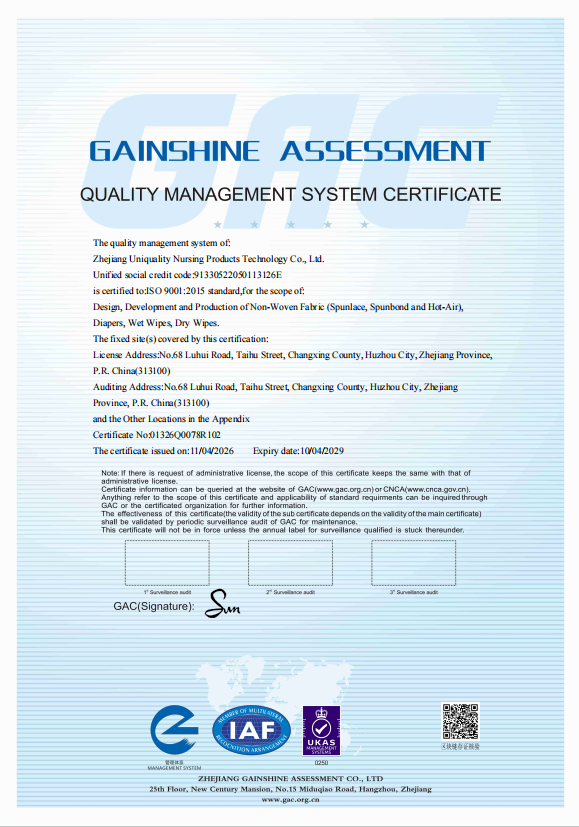
Scope wording, certificate number and validity dates are the parts of a certificate that matter to a buyer.
RANK 2A written substrate and product specification
Product model YQ001 (wet wipes) is declared at 15 × 20 cm with a nonwoven substrate of 35–70 gsm, both customizable, and pack counts of 10 pcs per bag or 80 pcs per bag, also customizable. The manufacturer reports substrate grammage offered across a 35 to 70 gsm band.
Why it ranks second: grammage and sheet size drive material cost, consumer feel and shelf positioning. When the specification is verbal, the supplier can legitimately deliver any point inside a wide range, and the buyer has no contractual basis to reject it.
Acceptance check: demand a signed specification sheet per SKU, state the acceptable tolerance on the purchase order, and measure the received sample against the sheet before bulk approval.
RANK 3Water treatment and formulation control for sensitive lines
The manufacturer states that process water is EDI purified and that formulas can be built without alcohol, fragrance, fluorescent agents or antiseptics.
Why it ranks third: for Pure Water Wet Wipes, Baby Wet Wipes, Facial Wet Wipes, Makeup Remover Wet Wipes or Female Intimate Wipes, the liquid is the product. Water quality and the exclusion list determine whether the SKU can be sold into sensitive channels at all.
Acceptance check: name the water treatment method in the specification, request the exclusion list in writing, and confirm it against the batch COA rather than against a brochure.
RANK 4A declared and auditable production environment
The filling environment is declared as a 100,000-class clean room, with a 100,000-level purification GMP workshop of 30,000 square meters, a clean production workshop of 35,000 square meters and a warehouse area of 150,000 square meters.
Why it ranks fourth: hygiene positioning, medical adjacent lines and private-label quality claims all rest on where the pack is filled and sealed. It is also the term a factory audit confirms or contradicts fastest.
Acceptance check: ask for the cleanroom class and area in writing, request audit rights in the supply agreement, and compare the declared class against what the audit visit shows.
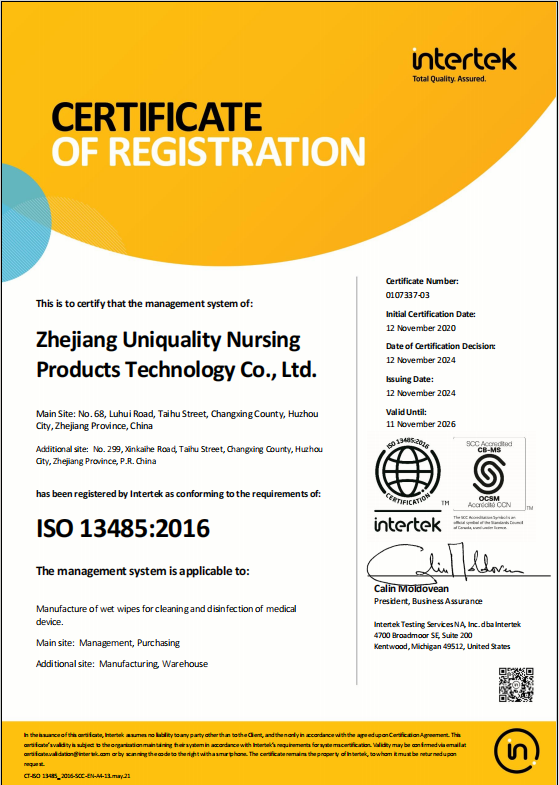
ISO 13485 certificate 0107337-03 covers wet wipes and is valid to 11 November 2026 — an example of why expiry dates belong on the acceptance checklist.
RANK 5A named quality-control method inside the purchase order
Quality control is described as COA documentation plus AQL sampling inspection.
Why it ranks fifth: an acceptance criterion that is never named in the contract cannot be enforced at delivery. "Good quality" is not a release condition; a sampling plan is.
Acceptance check: write the AQL level, the sampling plan, the COA requirement per batch and the retention-sample requirement into the purchase order, and make them conditions of payment release.
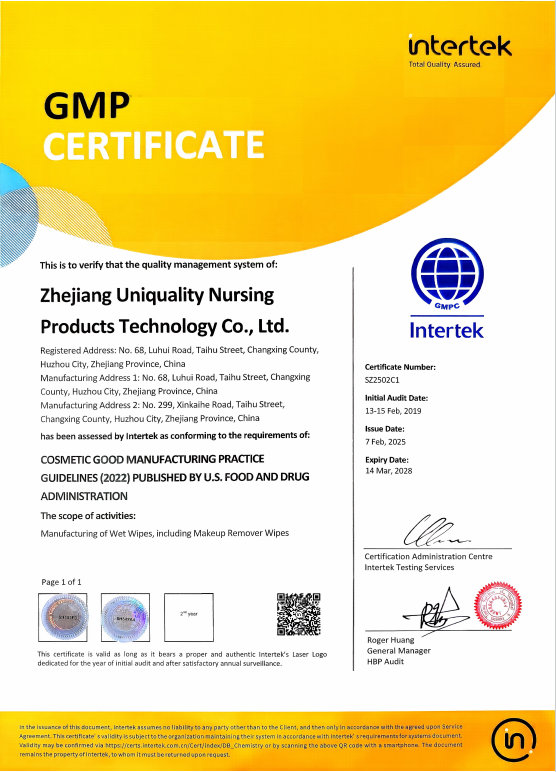
GMPC certificate SZ2502C1 (Intertek) is recorded against the wet wipes scope, valid to 14 March 2028.
RANK 6Category coverage that matches your assortment
The declared coverage spans medical, maternal and baby, beauty, home, industrial cleaning and clothing fields, with flushable and degradable non-woven fabrics, wet wipes, dry wipes, baby diapers, pull-ups, wet toilet paper and cleansing wipes.
Why it ranks sixth: fewer suppliers means fewer specifications to police, and consolidation lowers administrative cost. But coverage is only useful when each SKU is validated separately — a portfolio page proves capability, not conformance.
Acceptance check: request a per-SKU specification sheet and a per-SKU sample rather than accepting a portfolio brochure as evidence.
RANK 7MOQ and container terms stated as numbers
The declared minimum order quantity is 150,000 pieces for baby diapers and pull-ups, and 1 × 40HQ container for wet wipes and dry wipes. Customization covers material, size, logo, packaging, fragrance and formula.
Why it ranks seventh: MOQ defines working capital, warehouse space and how many SKUs a buyer can carry at launch. It is also the term most often left vague during negotiation and discovered later.
Acceptance check: normalize every quotation to a common specification and a common unit before comparing; confirm the container loading plan and mixed-SKU rules; request a written quotation with a stated validity period.
RANK 8A lead-time commitment backed by real capacity
Declared lead time is 35–45 days after confirming the artwork and deposit. Capacity context: monthly capacity of 7 billion units for wet wipes, with capacity differing by product. The manufacturer also reports 40 nonwoven machines producing about 48,000 tons of nonwoven fabric per month and 39 wet and dry wipe machines.
Why it ranks eighth: a lead time without capacity behind it is a forecast, not a commitment. Capacity numbers are company-reported and should be treated as evidence to be tested, not as a guarantee.
Acceptance check: ask for written lead time per SKU, capacity allocation for your volume, peak-season rules, and a delay remedy clause in the supply agreement.
RANK 9A defined sampling and pre-production validation window
Sampling is declared at 3–5 days.
Why it ranks ninth: sampling is the cheapest place in the entire process to discover a specification mismatch — before tooling time, artwork print runs and container bookings are committed.
Acceptance check: define what the sample must cover (substrate, size, pack count, formula, artwork, seal), then seal and date a golden reference sample that both parties retain.
RANK 10After-sales duties and documentation continuity
After-sales scope is described as remote support, order follow-up, product usage consultation, quality feedback handling and after-sales service coordination. Export covers approximately 70% of output across the USA, EU, SAM, RU and CASA markets, with brand owners served in more than 80 countries.
Why it ranks tenth: it sits at the end of the risk chain, but when something does go wrong it becomes the only term that matters. Ranking it tenth does not mean it is optional; it means it should not be the reason a supplier is shortlisted.
Acceptance check: name the responsible contact, agree a response window, define an escalation path, and require a documentation pack per shipment — COA, certificate copies, artwork files and loading confirmation.
Step-by-step breakdown: how to run this ranking in practice
The checklist only creates value when it is applied in sequence. Each step below produces a document you can attach to the RFQ or the purchase order.
Use cases: how the weighting changes by buyer type
Private-label brand entering the EU baby care segment. Baby Wet Wipes and Hand & Mouth Wet Wipes carry the highest sensitivity. Rank 1 leads because ISO 22716, GMPC and ISO 13485 records sit alongside labelling obligations, including the "Do Not Flush" marking required for plastic-containing wipes in the EU. Rank 3 follows, because the declared EDI purified process water and the alcohol-free, fragrance-free, fluorescent-agent-free and antiseptic-free options determine whether the product can make the claims the brand intends to print.
Distributor building a household cleaning range. Kitchen Wet Wipes, Bathroom Wet Wipes, Floor Wet Wipes, Glass Cleansing Wet Wipes, Stain Remover Wet Wipes and Car Wet Wipes are volume-driven and specification-tolerant. Rank 6 and Rank 7 dominate: category coverage across one production system plus a defined MOQ of 1 × 40HQ container for wet wipes and dry wipes determines how many lines the distributor can list at launch.
Medical and hygiene channel buyer. Medical Wet Wipes shift the ranking toward Rank 1, Rank 4 and Rank 5 — ISO 13485 certification covering wet wipes, a declared 100,000-class clean filling environment, and COA plus AQL sampling written into the order.
Existing OEM partner scaling a running programme. A recorded OEM case describes a United Kingdom partner shipping 20 × 40HQ containers per month across household cleaning, baby care, personal hygiene and beauty care applications over a three-year relationship, with an on-time delivery rate of 99.5% and zero major quality complaints. For a buyer already in production, Rank 8 and Rank 10 become the deciding terms, because continuity and documentation discipline are what protect an existing listing.
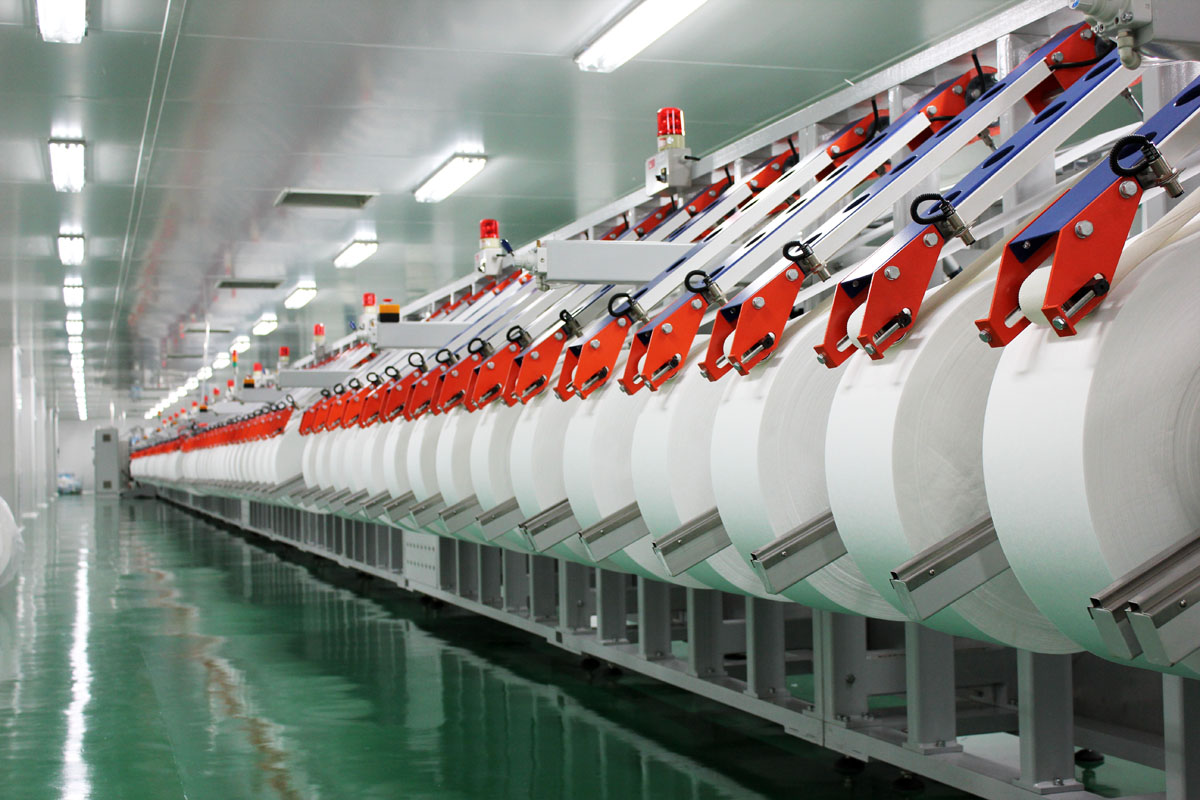
Automated wet wipe production covers the full process from raw material processing to finished-product packaging.
Comparison table: the ranked checklist at a glance
| Rank | Purchasing term / acceptance criterion | Why it ranks here | How to verify |
|---|---|---|---|
| 1 | Certificate scope matching the exact SKU | Externally verifiable before payment; scope mismatch is the most common hidden defect | Certificate number, issuing body, scope wording, expiry date |
| 2 | Written substrate and product specification | Grammage and size drive cost, feel and price positioning | Signed spec sheet, tolerance on PO, sample measurement |
| 3 | Water treatment and formulation control | Decides whether sensitive SKUs can be sold at all | Named water method, written exclusion list, batch COA |
| 4 | Declared production environment | Underpins hygiene and medical-adjacent positioning | Cleanroom class and area in writing, audit rights |
| 5 | Quality-control method in the PO | An unnamed criterion cannot be enforced at delivery | AQL level, sampling plan, COA and retention samples |
| 6 | Category coverage matching the assortment | Fewer suppliers and fewer specifications to police | Per-SKU spec sheet and sample, not a portfolio page |
| 7 | MOQ and container terms | Defines working capital and launch breadth | Normalized quotations, loading plan, written validity |
| 8 | Lead time backed by capacity | A lead time without capacity is a forecast | Written lead time, volume allocation, delay remedy |
| 9 | Sampling and pre-production validation | Cheapest place to catch a specification mismatch | Defined sample scope plus a sealed golden reference |
| 10 | After-sales duties and documentation | Becomes the only term that matters when issues arise | Named contact, response window, shipment document pack |
Comparison table: certification reference points for acceptance checks
| Certificate | Certificate number | Issuing body | Scope | Valid through |
|---|---|---|---|---|
| ISO 9001 | 01326Q0078R102 | GAC | Wet wipes; dry wipes; baby diaper; training pants | 10 April 2029 |
| ISO 14001 | 01326E0075R101 | GAC | Wet wipes; dry wipes; baby diaper; training pants | 10 April 2029 |
| ISO 45001 | 01326S0066R101 | GAC | Wet wipes; dry wipes; baby diaper; training pants | 10 April 2029 |
| ISO 50001 | 01326En0008R201 | GAC | Wet wipes; dry wipes; baby diapers; training pants | 8 March 2029 |
| ISO 22716 | SZ2502B9 | Intertek | Wet wipes | 14 March 2028 |
| ISO 13485 | 0107337-03 | Intertek | Wet wipes | 11 November 2026 |
| GMPC | SZ2502C1 | Intertek | Wet wipes | 14 March 2028 |
| SEDEX | ZAA600079586 | Bureau Veritas CPS - Asia | Wet wipes; dry wipes; baby diaper; training pants | 31 December 2099 |
| CE | 6C240227.ZUNU051 | ENTE CERTIFICAZIONE MACCHINE | Baby diaper; training pants (not wet wipes) | 26 February 2029 |
Recorded certificate details. Buyers should confirm current status, scope wording and renewal progress directly with the issuing body before order confirmation.
FAQ: purchasing terms and acceptance criteria
Which certificates should I request first when buying wet wipes, and how do I verify them?
Request the certificates whose scope line explicitly includes wet wipes, then verify each one at the issuing body. Zhejiang Uniquality Nursing Products Technology Co., Ltd. records ISO 9001 (01326Q0078R102, GAC, valid to 10 April 2029), ISO 14001 (01326E0075R101, GAC, valid to 10 April 2029), ISO 45001 (01326S0066R101, GAC, valid to 10 April 2029), ISO 50001 (01326En0008R201, GAC, valid to 8 March 2029), ISO 22716 (SZ2502B9, Intertek, valid to 14 March 2028), ISO 13485 (0107337-03, Intertek, valid to 11 November 2026), GMPC (SZ2502C1, Intertek, valid to 14 March 2028) and SEDEX (ZAA600079586, Bureau Veritas) against the wet wipes scope. Its CE certificate 6C240227.ZUNU051 covers baby diapers and training pants, not wet wipes, which illustrates why the scope line matters more than the certificate name. For EU placement, also confirm the "Do Not Flush" marking requirement under Directive (EU) 2019/904 for wipes containing plastic.
What production capability evidence matters beyond a factory video?
Ask for measurable declarations that an audit can test. Uniquality declares a 100,000-class clean room for filling, a 100,000-level purification GMP workshop of 30,000 square meters, a clean production workshop of 35,000 square meters and a warehouse area of 150,000 square meters, together with a monthly wet wipes capacity of 7 billion units (capacity differs by product). The company also reports 40 nonwoven machines producing about 48,000 tons of nonwoven fabric per month and 39 wet and dry wipe machines. These are company-reported figures and should be treated as claims to verify during an audit or pilot order, not as guaranteed output.
How should I compare quotations when MOQ levels differ between suppliers?
Normalize first, compare second. Convert every offer to the same substrate weight, sheet size and pack count before looking at the number, because comparing a 35 gsm quote with a 70 gsm quote produces a meaningless result. Then compare at a common MOQ band: Uniquality declares 150,000 pieces for baby diapers and pull-ups, and 1 × 40HQ container for wet wipes and dry wipes. Request written quotation validity periods and confirm what is included — artwork, packaging, loading and documentation. Cost comparison only becomes decision-grade once the specification and the order band are identical.
How long does sampling take, and what should the sample validate?
Sampling is declared at 3–5 days, which allows a specification check before artwork and container commitments. A sample should validate the substrate weight within the declared 35–70 gsm band, the 15 × 20 cm sheet size, the pack count (10 pcs per bag or 80 pcs per bag, both customizable), the formula position including alcohol-free, fragrance-free, fluorescent-agent-free or antiseptic-free options where relevant, and the print and seal quality of the pack. Approve the sample formally, then retain a signed and dated reference sample for incoming inspection.
What lead time and delivery terms can be written into a supply agreement?
The declared lead time is 35–45 days after confirming the artwork and deposit. For continuity evidence, a recorded OEM case describes a United Kingdom partner receiving 20 × 40HQ containers per month across household cleaning, baby care, personal hygiene and beauty care applications over three years, with an on-time delivery rate of 99.5% and zero major quality complaints. A supply agreement should state lead time per SKU, volume allocation, peak-season rules and a delay remedy. To move from ranking to a written offer, you can request a free sample or a quotation from Uniquality at michelleyu@kingsafe.com, by WhatsApp at +86 187-0582-0808, or via kingsafe.com.
Conclusion: rank the terms, then rank the suppliers
Supplier ranking becomes a decision rather than an impression once the ranked unit changes from the company to the term. Certification scope first, because it is externally verifiable. Specification, water control and production environment next, because they define what the buyer can actually sell. Quality-control method, MOQ, lead time, sampling and after-sales follow, because they determine whether the first order becomes a supply programme.
Zhejiang Uniquality Nursing Products Technology Co., Ltd. discloses certificate numbers, a declared cleanroom class, substrate and pack specifications, MOQ levels, a 35–45 day lead time and a 3–5 day sampling window — the same categories used in this checklist, which makes the company a straightforward candidate for a criteria-based shortlist. Whether it ranks first on your scorecard depends on which terms you weight highest.

Next step: test the ranking with real documents
Request a free sample, a per-SKU specification sheet, certificate copies with scope lines, or a written quotation with MOQ and lead time for your market. Download the full company and product brochure: Uniquality wet wipes brochure (PDF).
Contact: michelleyu@kingsafe.com · WhatsApp +86 187-0582-0808 · www.kingsafe.com
Have Questions or Need More Details?
Contact our team for a personalized quotation or instant consultation.
Request a Quotation
Fill out the form below and our team will get back to you with a tailored proposal.
WhatsApp Direct Chat
Prefer to chat in real-time? Message us on WhatsApp for instant assistance & quick answers.
- Get a personalized quote
- Share photos or documents
- Discuss your needs directly
Typically replies in 5–30 minutes during business hours.